

Carnival in Irpinia: The Zeza between past and present
The Zeza is an ancient tradition that harks back to Latin comedy and the masked theatre of the regional Commedia dell’Arte.


The village of Avella, in the province of Avellino, lies along the banks of the Clanio stream and is a site rich in history and, therefore, of archaeological interest. Today, Avella boasts a noteworthy archaeological heritage, including the remains of a Roman amphitheater, an aqueduct, a necropolis, and the Lombard castle, also known as the Castle of San Michele for the cult of the warrior Archangel.
The Origins of the Castle
The castle stands 320 meters above sea level, on a hill with the Clanio stream flowing along its slopes. Behind it, a veritable natural barrier, the Avella Mountains, separate the Avellano-Baianese district from the Caudina Valley. The monumental complex of Avella Castle therefore enjoys a truly strategic position for controlling the surrounding territory, a necessary requirement for the effectiveness of fortresses erected at that time.
The castle was built by the Lombards in the 7th century AD and was subsequently involved in numerous conflicts throughout its history, undergoing the domination of many of the foreign peoples who ruled Campania, including the Lombards, the Normans, the Angevins, and finally the Aragonese, who were responsible for the construction of other historic buildings in the area. Destroyed by continuous enemy incursions and rebuilt as many times, it was finally rebuilt by the Normans, who transformed it into a noble residence. Partially demolished by the earthquake of 1456, it was rebuilt by Pietro Spinelli in 1553 but, despite costly restoration, was completely abandoned towards the end of the 16th century.
The existence of the Avellano Castle is mentioned in the Historia Longobardorum by Erchemperto (a Benedictine monk who wrote the Lombard chronicle that recounts the events of the Principality of Benevento from 787 to 889), which states that it was owned by Guaimaro I and that Prince Landolfo Suessolano took refuge there after the sacking of his city by the African Vandals.
Archaeological investigations began between 2000 and 2001 by the Superintendency for Archaeological Heritage of the provinces of Salerno, Avellino, and Benevento, focusing on the fortress, with the aim of establishing an initial periodization of its occupation phases.
Among the most important finds concerning the castle is certainly the Cippus Abellanus. This limestone plaque dates back to 150 BC and is currently preserved in the Episcopal Seminary of Nola. This find represents the signing of an agreement between the ancient cities of Avella and Nola. The ultimate goal of this agreement was to establish the demarcation of the borders belonging to the two territories and the joint management of the Roman temple dedicated to Hercules that the two municipalities shared.
After so many centuries of history, the sumptuous original structure of Avella Castle currently appears, aesthetically, in ruins. However, emotionally, it can be safely said that, walking on the hill on which the remains of the structure stand, one senses a highly evocative atmosphere, further enhanced by the panorama that stretches across the Campania countryside, all the way to Vesuvius.
It should be noted that a visit to this area is part of a tourist route that also includes the amphitheater and the funeral mausoleums of the archaeological area. About 1 km from the Castle, there is a trail suitable for trekking, on foot, by mountain bike, or on horseback. The route starts from Avella Castle and arrives at Tuppo Tuotolo at an altitude of 1215 meters. As it climbs, the view of the Gulf of Naples opens up more and more.

The Zeza is an ancient tradition that harks back to Latin comedy and the masked theatre of the regional Commedia dell’Arte.

Arroccata sulle alture dell’Alta Irpinia, Guardia Lombardi occupa da secoli una posizione privilegiata. Il paese si trova lungo un suggestivo spartiacque naturale. Il suo inconfondibile profilo domina un paesaggio fatto di montagne, vallate e campagne. Per chi visita Guardia Lombardi centro storico e belvedere rappresentano un’unica meravigliosa esperienza panoramica. Questa posizione spiega bene l’importanza strategica […]

Da antica fortezza medievale a simbolo della rinascita dopo il sisma del 1980, il Castello Ruspoli rappresenta uno dei principali poli culturali irpini.

The Avellino Customs House: a journey from its origins to the present day, through the vicissitudes and restorations of the Palazzo della Dogana

Discovering Greci, the only municipality in Irpinia characterized by the presence of the Arbëreshë community, the Albanians who have resided in Italy for centuries.

The history of the Irpinia castles in the province of Avellino: from medieval castrums to sumptuous Renaissance-style noble residences.

Antiche mura, reperti archeologici e musei raccontano oltre mille anni di storia, facendo del Castello degli Imperiale uno dei luoghi simbolo dell’Alta Irpinia.
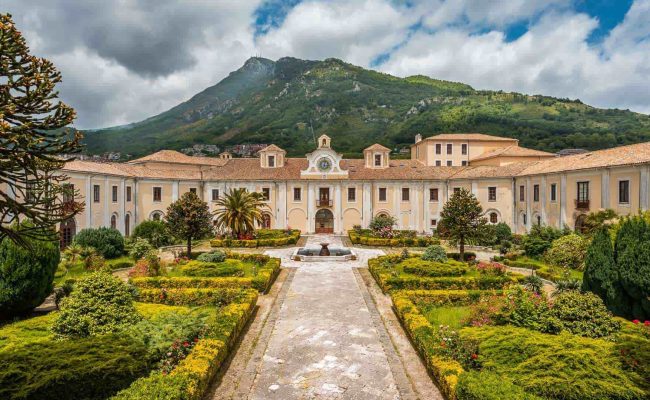
Architetture barocche, antichi manoscritti, e una storica farmacia: l’Abbazia di Loreto custodisce un patrimonio straordinario. Scopri uno dei complessi monastici più affascinanti d’Irpinia.


