Montecalvo Irpino, like every municipality in our beautiful Irpinia, boasts a fascinating history that deserves to be discovered, not only to understand what has brought us to the present but above all to understand and communicate who we really are today. We spoke about it with Gianluca Cardinale of the “I Pupini” Association.
The Municipality of Montecalvo Irpino
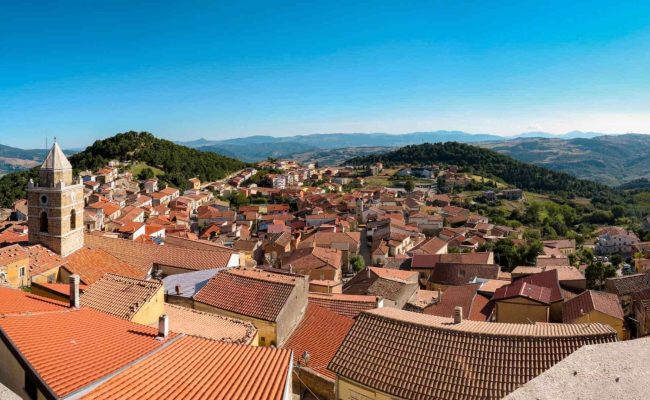
Montecalvo Irpino is located in the northern province of Avellino and has just under 3,500 residents. The center of the municipality, which is part of the Ufita Mountain Community, is at an altitude of 623 meters above sea level.
Typical of the rural area of Montecalvo Irpino are the Bolle della Malvizza, small mud volcanoes that emerge in the middle of the Miscano Valley.
The origin of the name
Why is Montecalvo Irpino called that? There are three possible hypotheses, admits Gianluca Cardinale. In the first, the name derives from the Latin Mons Calvus, meaning “Rocky Mountain, devoid of vegetation.” In the second case, however, it refers to Mons Galbus, “Yellow Mountain” due to both the color of the tuff and – above all – the broom plants. These have always characterized the landscape of this small town.
Equally fascinating is a third hypothesis, the one reported in the book “Montecalvo from Stones to History,” edited by Giambosco Cavalletti, an esteemed professor and passionate scholar of local history. According to Cavalletti, the town’s name may even date back to a family, the Caldia family, who held possessions here in Roman times.
Which of the three hypotheses seems most realistic to you?
The ancient and medieval history of Montecalvo Irpino
In addition to a geologically and naturalistically remarkable territory, Montecalvo Irpino also boasts a history of some importance. The municipality boasts not only several ancient remains of walls and necropolises but also various archaeological finds. Significant references can also be found in various historiographical sources.
The first mention of Montecalvo is found, as Gianluca confirms, in a chronicle from 1096, which tells of an expedition of about sixty armed men from that area headed for the Holy Land at the behest of William the Good.
From 1300, the village of Montecalvo began to follow the fate of nearby Ariano Irpino, to which it was annexed, until, in 1456, a violent earthquake destroyed part of its town center. This tragedy resulted in the subsequent relocation of the houses to the area outside the city walls.
Montecalvo and Modernity
In the following centuries, Montecalvo lived under various duchies and fiefdoms, passing from French to Spanish families.
A particular aspect of Montecalvo’s more recent history lies in its connection with the anti-Bourbon uprisings of the Risorgimento. During the constitutional uprisings of 1820-1821, several volunteers left Montecalvo to fight against the Austrians in the Battle of Antrodoco, under the command of the rebel General Guglielmo Pepe.
Coming to the first half of the 20th century, equally noteworthy – Gianluca Cardinale recalls – is the visit to the town of Umberto II, the last king of Italy. Passing through here on political business, he is immortalized with local women dressed in traditional dress, the so-called Pacchiane, already famous in the Kingdom of the Two Sicilies and still present in the village’s tradition, especially during Carnival.
There are also numerous socialist-inspired pronouncements in Montecalvo, which see laborers and intellectuals interacting, united by a single, great goal: to improve their miserable living conditions. These libertarian energies remained active even during Fascism; In fact, in 1944, the local branch of the Communist Party was founded in Montecalvo.
In the immediate post-war period, Montecalvo was the one in Irpinia that most supported the Republic during the institutional referendum of June 2, 1946, dispelling the cliché that a small community cannot be sensitive to major historical events and changes.
Fun Facts
Did you know that Montecalvo was the town in Irpinia that most favored the Republic in the institutional referendum of June 2, 1946? The evidence therefore dispels the cliché that a small community cannot be sensitive to major historical events and changes.
The “I Pupini” Cultural Association
The “I Pupini” cultural association for the promotion of tourism and the territory, officially founded in 2017, is fully committed to the promotion of Montecalvo.
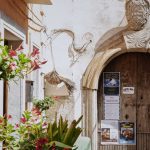
In particular, it has recently “adopted” two characteristic places in the town: the small square with the panel depicting the Pacchiana di Montecalvo and the famous Vicoletto degli Innamorati, which “I Pupini” constantly maintain and clean.
Furthermore, during the Santa Caterina Fair, which has been held for over half a millennium, the Association’s calendar is presented every year.
One of the future ideas is to establish a Diffused Museum.
Experience the extraordinary Irpinia Box to enjoy the village’s splendid landscapes and visit the local architectural beauties!