


The Flavors of Easter in Irpinia
Irpinia is a land of deep-rooted traditions, which also find their expression on our tables during the heartfelt Easter season.


The priest’s chestnuts are a typical Christmas treat. In ancient times, they were prepared only in the province of Avellino, specifically in the Irpinia municipality of Montella, famous especially for its chestnut production, a DOP recognized product throughout the area. Today, however, they are also known and appreciated throughout the rest of Campania.
This specialty is the result of a mistake, or rather, an accident! Legend has it that a priest, after loading his mule with a large quantity of chestnuts, was returning to the convent. But the mule, unable to carry the weight of the chestnuts, stumbled and rolled all the chestnuts into a river. The priest, undaunted, began to collect the chestnuts one by one from the water, amidst the laughter and jeers of the local population. Upon returning, the priest decided to bake the chestnuts to dry them: a true delicacy was born, with the chestnuts becoming crispy on the outside but soft on the inside. The recipe, naturally, took the name “priest’s chestnuts.”
The production process is strictly artisanal and gives the product a unique and unmistakable flavor. After the harvest in October, the production process consists of three main phases: drying, roasting, and soaking. A technique that has remained unchanged over time.
Drying. Freshly harvested chestnuts are decidedly moist, so they are dried in “gratai,” structures heated by burning chestnut wood for ten days at a constant rate. This phase reduces the water content in the chestnuts and imparts a characteristic smoky aroma to the product.
Toasting. Immediately afterward, the chestnuts are toasted in very high-heat ovens, where the browning of the sugars in the chestnuts further enhances the product’s organoleptic characteristics.
Bathing. The final phase, also known as hydration, involves the “priest’s method.” To prevent the chestnuts from drying out, they are soaked in water (sometimes even in water and wine) for seven days, twice a day, until they are rehydrated and soft again.
At the end of this ancient and laborious process, you get these soft, sweet, and tasty “castagne del prete” (priest’s chestnuts), ready to eat with a unique texture!
Although the process remains the same, there are two variations:
the “castagne del prete” (priest’s chestnuts) are called “infornate” (baked), “nvornate” (baked) in the local dialect, when they are shelled before being placed on the fire;
Instead, when, despite being left on the racks, they remain moist and therefore “soft,” they are removed from the heat and threaded, like a crown, onto a string and hung up to be eaten. This type, also called “tenderella,” is widely sold because it is particularly sweet and can be stored for up to 3-4 months.
Now it’s your turn, prepare them and enjoy them!
Did you know that “castagne del prete” can also be prepared at home? The process is quite easy, as long as you have the right tools. Here are the ingredients you need: 1 kg of chestnuts; 1 liter of water; 200 ml red wine (optional).
As already mentioned, the process consists of three phases.
The first phase involves roasting the chestnuts on a grate with a fire underneath: a barbecue or fireplace will work fine. The chestnuts, whether scored or not, must also be smoked a little in addition to roasting. Once roasted, the chestnuts are left to cool.
The second phase involves toasting them in the oven for 50-60 minutes at a temperature no higher than 120°C: the chestnuts, in the end, should be dry and crunchy.
The third phase involves letting the chestnuts cool again and immersing them in water and wine, just wine, or just water, for a week. Once this step is complete, the chestnuts should be drained well and left on a rack for 15-20 minutes to dry completely.
Tip: How to store chestnuts
Once prepared, however, the soaked chestnuts should be eaten within the same day. However, if you want to avoid having to eat them all, proceed with steps 1 and 2 without soaking them. Store them dried and then soak them just a week before serving.

Irpinia is a land of deep-rooted traditions, which also find their expression on our tables during the heartfelt Easter season.

Ravece extra virgin olive oil, produced in the Ufita Valley, is widely used in cooking thanks to its many properties.

Gesualdo celery, a Traditional Agri-Food Product and Slow Food Presidium, is known for adding flavor to many traditional Irpinia dishes.

Among the typical flavors of Irpinia, laene and fasuli is a dish rooted in the history of the area and intimately linked to the agricultural world.

In Volturara Irpina, a very typical bean is grown, a culinary delight with strong connections to the local culture: the Quarantino bean.
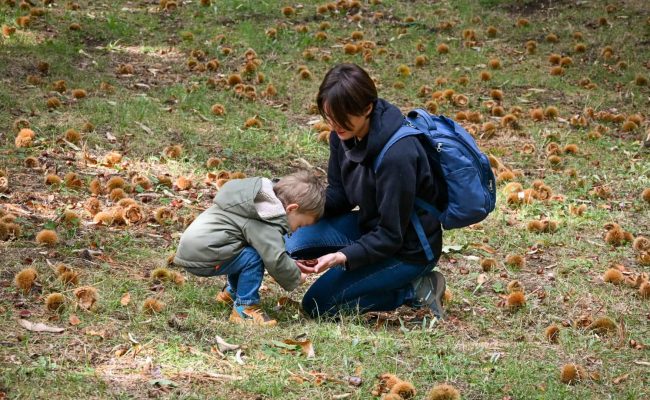
A Montella l’autunno si riconosce da un gesto molto semplice. Le persone si chinano tra le foglie secche e raccolgono i frutti appena caduti. Tra ottobre e i primi giorni di novembre, i boschi diventano i luoghi più vivi dell’intero territorio. La raccolta autunnale coinvolge attivamente produttori, intere famiglie e numerosi visitatori. Questo periodo non […]

Pecorino di Carmasciano, produced in the Ansanto Valley, between Rocca San Felice and Guardia dei Lombardi (AV), is an exquisite PAT cheese.

Discover Taurasi, the village that gave its name to the famous DOCG wine, with five thousand years of history, a thousand-year-old castle and a rich cultural heritage.


